Historically, Planck's explanation (1900) of black-body
radiation was the first quantum description of a physical phenomenon.
Black-body is a perfect absorber of incident radiation. Because of
thermal equilibrium, it is also the best emitter of radiation. It may
be simulated by a hole grilled in a cavity. Experimentally, the
radiation emitted by a black-body has a well-defined intensity
distribution as a function of wavelength , which has a
maximum at some wavelength . As the temperature of the
black-body is raised, the radiation intensity increases at all
wavelengths and shifts to a smaller value such that
(2.20)
known as Wien's displacement law (1993). To start with we have e.m.
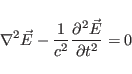
radiation described by the wave equation
(2.21)
which follows from the Maxwell's equations. The solutions to this
equations are of the type
(2.22)
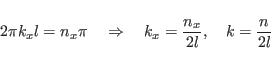
where is the wave number. For the radiation confined to
a cubic box of length , the boundary conditions imply