Module 4 : Many-body formalism and introduction to strongly correlated bosonic and                    fermionic systems.
Lecture 16 : Many-body physics in second-quantized language
 

For consistency, we also postulate that the single particle state $\vert\phi\rangle$ itself can be obtained from the vacuum state $\vert\rangle_\zeta$ by the action of this creation operator:

\begin{displaymath}
\vert\phi\rangle = a^\dagger(\phi)\vert\rangle_\zeta
\end{displaymath} (2)

We now ask: What is the adjoint of this operation? To answer this, denote the adjoint as usual by $a(\phi)$ and note that

$\displaystyle \;_\zeta\langle x_1 \cdots
x_{n-1}\vert a(\phi)\vert\psi_1 \cdots \psi_n\rangle_\zeta$ $\textstyle =$ $\displaystyle (\;_\zeta\langle \psi_1 \cdots \psi_n\vert a^\dagger(\phi)\vert x_1 \cdots
x_{n-1}\rangle_\zeta)^\star$  
  $\textstyle =$ $\displaystyle \;_\zeta\langle \psi_1 \cdots \psi_n\vert\phi,x_1 \cdots
x_{n-1}\rangle_\zeta^\star$ (3)
From the previous lecture, we know that this can be written as
$\displaystyle \;_\zeta\langle \psi_1 \cdots \psi_n\vert\phi,x_1 \cdots
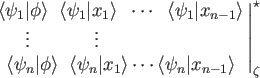
x_{n-1}\rangle_\zeta^\star$ $\textstyle =$ $\displaystyle \left\vert\matrix{\langle \psi_1\vert\phi\rangle \; \; \langle\ps...
...rt x_1\rangle \cdots \langle
\psi_n\vert x_{n-1}\rangle}\right\vert^\star_\zeta$ (4)