| |
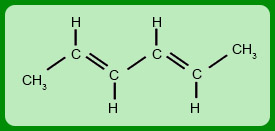 |
| Figure 18.3 A polyene dye with 2 conjugated double bonds. |
In all these molecules, the CH3 groups can be replaced by other monovalent groups without significantly changing the optical spectra of the molecule.
In the symmetric cyanines the exchange of single and double bonds still satisfies all the valence of all atoms, so as in the case of benzene the conjugated bond chain is expected to have all bonds of equal length the effective potential seen by p electrons then is periodic with a period equal to one bond length. However, in polyenes, this is not true and thus single and double bonds have different lengths and the the effective potential seen by π electrons is periodic with period equal to the sum of single bond length+ double bond length. This has important consequences for their optical properties. In the spirit of empirical pseudo-potential theory of semiconductors, we can say that cyanines are like a 1-dimensional free electron gas with periodic potential with period  whereas polyenes are like a 1-dimensional free electron gas with periodic potential with period whereas polyenes are like a 1-dimensional free electron gas with periodic potential with period  . Thus, for infinite length a cyanines is like a one dimensional metal while a polyene is like a semiconductor because for cyanines there is one π-electron per unit cell while for polyenes there are two (because the unit cell has two atoms and each atom contributes one π-electron). The π-electrons in a cynine with j conjugated double bonds can thus be represented by 2j+2 free electrons in a box of length . Thus, for infinite length a cyanines is like a one dimensional metal while a polyene is like a semiconductor because for cyanines there is one π-electron per unit cell while for polyenes there are two (because the unit cell has two atoms and each atom contributes one π-electron). The π-electrons in a cynine with j conjugated double bonds can thus be represented by 2j+2 free electrons in a box of length  . A polyene with j conjugated double bonds is similarly represented by a box of length with the potential varying as . A polyene with j conjugated double bonds is similarly represented by a box of length with the potential varying as  . This model for dyes has been in use for a long time and was first described elegantly by Kuhn [H. Kuhn, Fortsh. Chem. Org. Nat. 16 (1958) 169; ibid, 17 (1959)404]. He also showed that the model gives a good account of absorption maxima and their strengths. Calculations of linear and nonlinear polarizabilities based on this model provided interesting insights into the nature of nonlinear polarizabilities. We discuss this now. . This model for dyes has been in use for a long time and was first described elegantly by Kuhn [H. Kuhn, Fortsh. Chem. Org. Nat. 16 (1958) 169; ibid, 17 (1959)404]. He also showed that the model gives a good account of absorption maxima and their strengths. Calculations of linear and nonlinear polarizabilities based on this model provided interesting insights into the nature of nonlinear polarizabilities. We discuss this now. |
|
|
|
