However, even for small fields, higher order terms may become important when resonant enhancement of susceptibilities occurs. A different, non-perturbative theory is then required. The other case in which greater sophistication of the theoretical treatment is necessary is when the laser field exceeds the atomic field. This is covered under extreme nonlinear optics. |

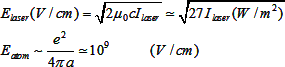

 can also excite higher multipoles which are neglected. The smallness parameter in the multipole expansion is atomic size/ wavelength of light. This too may need modification near a surface where the fields vary rapidly.