| |
using the definition of  -function as -function as |
|
and
 .
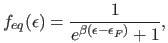
Although this result has been obtained using classical ideas, for the quantum case of electrons one can use the Fermi-Dirac distribution for .
Although this result has been obtained using classical ideas, for the quantum case of electrons one can use the Fermi-Dirac distribution for
 , ,  , , |
|
where
 is the Fermi energy for the electrons, so that, putting is the Fermi energy for the electrons, so that, putting
 and and
 , one gets (integrate the numerator by parts assuming , one gets (integrate the numerator by parts assuming  ), ), |
|
(25) |
|
|
|