| |
| This leads to |
|
(6) |
where  is the conductivity defined |
|
(7) |
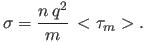
This formula is known as Drude-conductivity formula. In semiconductors,  is replaced by the effective mass  of the carrier. Clearly, the friction term leads to Ohm's Law, i.e., is independent of the electric field strength. |
In elementary derivations of Drude formula found in introductory text books of Solid State Physics, one uses the concept of collision time  . As the carriers drift through the solid, they occasionally collide, for instance, with the vibrating atoms/ions in the lattice, and one would anticipate the existence of a mean free time between the collisions or scattering. The average time interval between
successive collisions is the collision time , which is of the order of  . |
Note that
 is the resistivity (with unit  cm = Volt cm/Amp) so that the mobility  has the unit of cm2/(Volt sec). To get an idea about the order of magnitude for , note that  = 1.76  1015cm2/Volt and taking  sec (inverse of a typical lattice vibrational frequency), one gets  176 cm2/(Volt sec). In  -type Germanium (Ge),  , and
sec at room temperature, so that for this material at room temperature is 1760 cm2/(Volt sec), which agrees in order of magnitude with the observed mobility of 3900 cm2/(Volt sec). |
|
|
|