| |
This is known as Havriliak-Negami formula where  and and  are empirical parameters, depending upon the nature of the experimentally
observed response; usually one finds are empirical parameters, depending upon the nature of the experimentally
observed response; usually one finds  and and  .
When .
When  ,
one gets the classical Debye relaxation. When ,
one gets the classical Debye relaxation. When  and and  ,
then the formula is known as Davidson-Cole formula. When ,
then the formula is known as Davidson-Cole formula. When  and and  ,
then the formula is known as Cole-Cole formula. ,
then the formula is known as Cole-Cole formula. |
| A further empirical
generalization of above is |
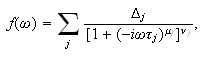 |
| where the sum over j represents different dielectric relaxation processes presumably arising from
different components in the material. |
|
|
|
