| |
Consider now the special case where  is along one of the principal axes, say, the is along one of the principal axes, say, the  -axis.
Then if -axis.
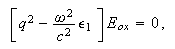
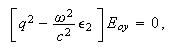
Then if  is referred to principal axis, these equations reduce to is referred to principal axis, these equations reduce to |
 |
 |
| and |
 |
If  ,
then ,
then  , i.e., the wave is transverse, the
remaining component having the solutions, , i.e., the wave is transverse, the
remaining component having the solutions, |
 |
 |
so that the plane wave can propagate along the  -axis
without a change in polarization if they are either -axis
without a change in polarization if they are either  -polarized
or -polarized
or  -polarized.
The complex refractive indices for these two types of waves are different -polarized.
The complex refractive indices for these two types of waves are different |
 |
|
|
|
