| |
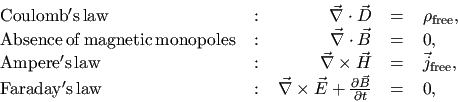
| The set of four equations |
|
are called Maxwell's equations. The quantity
 has the dimension of has the dimension of
 , and Maxwell called it Displacemnt current. These equations form the basis of all classical electromagnetic phenomena. , and Maxwell called it Displacemnt current. These equations form the basis of all classical electromagnetic phenomena. |
The electric displacement field  and the magnetic field and the magnetic field  are defined by are defined by |
|
where
 electric polarization = average electric dipole moment per unit volume, electric polarization = average electric dipole moment per unit volume,
 magnetization = average magnetic dipole moment per unit volume, magnetization = average magnetic dipole moment per unit volume,
 the free space permittivity and the free space permittivity and  the free space permeability. Note that the free space permeability. Note that  - relationship implicitly assumes that is entirely due to dipole moments, and the contributions from quadrupole and higher moments are negligible. - relationship implicitly assumes that is entirely due to dipole moments, and the contributions from quadrupole and higher moments are negligible. |
|
|
|