| 2. Cherenkov: intuitive understanding and applications (contd..) |
| Identifying neutrinos in a water Cherenkov detector |
 |
- When neutrinos interact in
water, they may produce an
electron, positron or muon
(depending on whether
they were
 or or ) which is energetic enough
to travel faster than the
speed of light in water. ) which is energetic enough
to travel faster than the
speed of light in water.
|
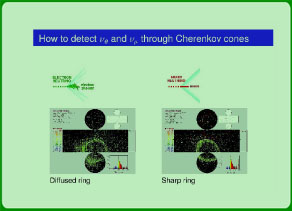
- These energetic charged particles produce "Cherenkov cones",
which are detected by photomultiplier tubes.
- The Cherenkov cones of electron/positron and muon look
different since the muon does not undergo much scattering. This
helps distinguish between electron neutrinos and muon
neutrinos.
- The first confirmed evidence of neutrino oscillations came from a
water Cherenkov detector (Super-Kamiokande).
|
|
|
|
|
|
