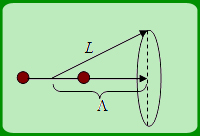
The “terms” tell us the values of certain angular momenta. In the case of molecule, we have to define the angular momenta in terms of the orbital angular momentum L and the spin angular momentum S of the atoms.
As we know that in the atom L and S are the good quantum numbers when we determine the terms because the motion of the electrons in an atom takes place in a spherically symmetrical field of nuclear force.
In case of spin orbit coupling, L and S couple to give total angular momentum J (= L + S).
In case of linear molecule, the symmetry of the field in which the electrons move is reduced.
There is only axial symmetry about the internuclear axis (the cylindrical symmetry) created by the strong electric field of the nuclei. This destroys the relationship between J, L and S. Not only that even the L ceases to be the good quantum number. As a consequence, only the component of L along the inter-nuclear axis is a constant of motion or good quantum number.
In an electric field, unlike the magnetic field, reversing the directions of motion of electrons does not change the energy of the system. Which means that the energies of ML = +1 and ML= -1 will be degenerate. Therefore, it is convenient to classify the electronic states of diatomic molecules according to the values of | ML | not L.
Thus we define the projection of L along the inter-nuclear axis as L as shown in figure-34.1. |