In the beginning of the 20th century, several experiments and observations could not be explained by Classical Physics. These are
- Photoelectric effect
- Compton effect
- Phenomena on atomic scales such as classical explanation of Rutherford model, discrete energy levels of atoms proposed by Bohr.
These facts forced the scientist to search for a near explanation of the mechanics.
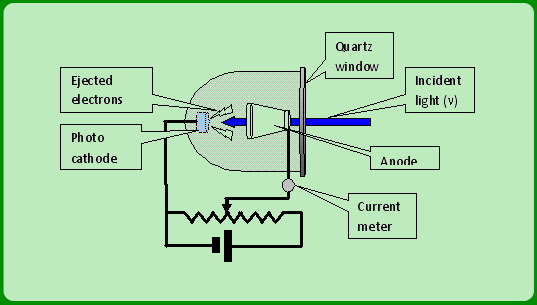
In 1886 and 1887, Heinrich Hertz showed that an electric discharge between the two electrodes shown in the Figure – 4.2) occurs when ultraviolet light falls on one of the electrodes.
In this a metallic cathode and anode are placed in a vacuum chamber having a quartz (clear to UV light) window. UV light having with frequency (n) is incident on cathode and the current generated by this light is measured through a current meter. |