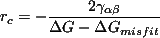
As in the case of homogenenous nucleation of a solid from its undercooled melt, in this case also, we are interested in calculating the critical size of the nucleus for homogeneous nucleation and the associated free energy changes.
In the case of a solid-solid phase transformation, in addition to the changes in bulk free energy and interfacial energy, typically, there is also a strain energy contribution which needs to be accounted for; this is because, typically, the volumes of the original  and the resultant and the resultant  are not the same, and unlike fluids, solids can support shear stresses. This strain energy (known as misfit energy because this is related to the imperfect fitting of the transformed phase into the original volume) can be shown to be proportional to the volume of the tranformed phase. It is in this respect that the homogeneous nucleation of precipitation differs from that of the solid from its pure melt. are not the same, and unlike fluids, solids can support shear stresses. This strain energy (known as misfit energy because this is related to the imperfect fitting of the transformed phase into the original volume) can be shown to be proportional to the volume of the tranformed phase. It is in this respect that the homogeneous nucleation of precipitation differs from that of the solid from its pure melt.
In other words, during solid-solid transformation, |


 is the total change in free energy,
  , the driving force for the transformation,
  is the free energy per unit area of the
  interface (of area
  ), and
  is the misfit or strain energy per unit volume of the
  where
where  is the index of planes that enclose the precipitate (with the interfacial energy being
  and area being
  for the