Part I : Preliminaries (Thermodynamics and Kinetics)
Module 4: Driving force for diffusion
5.2 Free energy minimization as the driving force for
diffusion
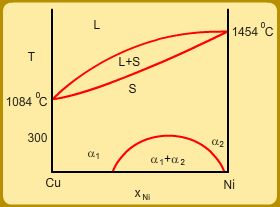
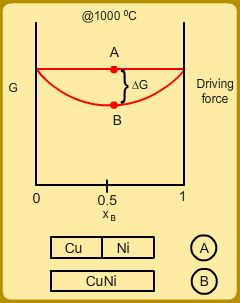
Consider the Cu-Ni phase diagram as shown in Fig. 20. Let we weld a block of copper to a block of nickel at keep it at 1000° C; let the overall composition be 50 wt.% nickel. The schematic free energy versus composition diagram at this temperamture is as shown in Fig. 21. Since the system prefers a complete solid solution and since the initial configuration is a mechanical mixture of pure copper and pure nickel, there is a driving force for the mechanical mixture to turn into a solid solution. In other words, like any spontaneous change, in this case too, the minimization of free energy will drive the process of compositional homogenisation. However, since copper and nickel are in the solid state, it takes a finite time to achieve the compositional homogenisation. This time needed for the homogenisation is decided by the kinetics of the diffusion process.
Figure 20: Schematic copper-nickel phase diagram.
Figure 21: Free energy versus composition diagram at 1000° C.
In general, the process described above is true for almost all phase transformations. A study of the thermodynamics can only tell us whether a transformation is possible or not, and the driving force for the transformation when it is possible. However, how fast or slow the transformation is going to be is decided by the kinetics. In most of the transformations discussed in these notes, it is the kinetics of diffusion which decides the time taken for the completion of the transformation; further, as we describe later, the diffusion process is a thermally activated process; hence it is very sensitive to changes in temperature.