Part I : Preliminaries (Thermodynamics and Kinetics)
Module 1: Gibbs free energy and equilibria
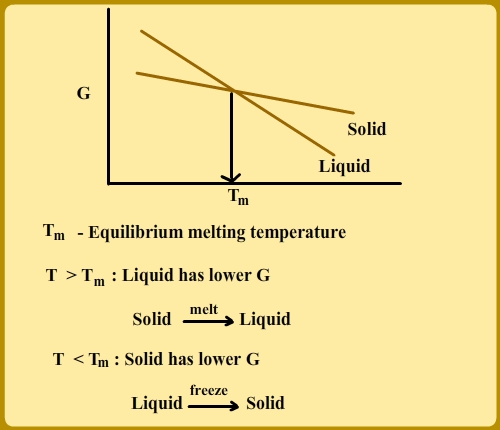
In materials also, an analogous situation with respect to internal atomic configurations and Gibbs free energy exist. Phase transformations take place when the internal configurations in a material correspond to the unstable or metastable equilbrium for the given parameters. Thus, to answer the question raised at the beginning of this module, when the temperatures are below 0° C, the solid form has a lower Gibbs free energy compared to the liquid and vapour form of water. In a similar manner, the Gibbs free energy for the liquid form is the lowest in the temperature range 0 to 100° C and that of vapour is the lowest above 100°C . This automatically leads to the definition of equilibrium transformation temperature (See Fig.3 ): it is the temperature at which the two phases have the same Gibbs free energy and hence co-exist; below and above the temperature, one of the phases becomes the phase with the lower free energy and hence is preferred.
Figure 3: The definition of equilibrium transformation temperature.
The Gibbs free energy can be calculated given the Cp, the specific heat capacity at constant pressure [1].