


Next: Tutorial problems and questions Up: Module 1. Spinodal decomposition Previous: Spinodal mechanism
Consider a system with an interdiffusion coefficient 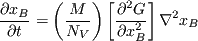 and undergoing spinodal decomposition.
Within the spinodal region, the composition fluctuations grow
as shown in Fig. 5; the fluctuations
grow with a characteristic time constant
and undergoing spinodal decomposition.
Within the spinodal region, the composition fluctuations grow
as shown in Fig. 5; the fluctuations
grow with a characteristic time constant
 where
where  is the wavelength of the composition modulation (assuming
one-dimensional modulations). Thus, for smaller ,
the rate of transformation becomes high; however, there
is a minimum below which spinodal decomposition
cannot occur; this is because, during spinodal decomposition,
as A- and B-rich regions are forming, there are also
interfaces between these regions where AB bonds are formed
which are energetically costlier; these regions give rise
to an increase in free energy; the `incipient' interfacial energy
associated with the formation of these regions with large AB bonds
are the ones which set the lower wavelength limit. The lower limit
on the wavelength can be obtained using the following
argument.
is the wavelength of the composition modulation (assuming
one-dimensional modulations). Thus, for smaller ,
the rate of transformation becomes high; however, there
is a minimum below which spinodal decomposition
cannot occur; this is because, during spinodal decomposition,
as A- and B-rich regions are forming, there are also
interfaces between these regions where AB bonds are formed
which are energetically costlier; these regions give rise
to an increase in free energy; the `incipient' interfacial energy
associated with the formation of these regions with large AB bonds
are the ones which set the lower wavelength limit. The lower limit
on the wavelength can be obtained using the following
argument.
Consider a homogeneous alloy of composition  decomposing
into two parts: one with composition
decomposing
into two parts: one with composition
 and another
with composition
and another
with composition
 . It can be shown that the total
free energy change associated with this decomposition is
. It can be shown that the total
free energy change associated with this decomposition is
As noted earlier, the AB bonds in the incipient interface regions
also contribute to the free energy; this free energy contribution,
thus, is associated with the gradients in composition. Consider
a sinusoidal composition modulation of wavelength
and amplitude 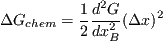 ; the maximum composition gradient is thus
 and the gradient energy contribution is
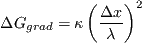 is a proportionality constant which is dependent
on the difference between AB and AA and BB bond energies.
is a proportionality constant which is dependent
on the difference between AB and AA and BB bond energies.
The total change in free energy associated with a composition
fluctuation of wavelength is thus given by the addition
of the chemical and gradient terms (Eqns. 5 and 6):
From the above expression, it is clear that for spinodal decomposition
 |
(8) |
Or,
 |
(9) |


