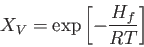
Defects that reduce the free energy of the system, and hence exist in a material at equilibrium are known as equilirbium defects. Point defects, especially vacancies are the equilibirum defects; they exist in all materials at temperatures above absolute zero. The fraction of lattice sites that are left vacant at any temperature T is given by the expression:
 |
(1) |
where  is the number of vacancies per mole of the material,  is the enthalpy of formation of vacancies, and R is the universal gas constant. For example, given that the enthalpy of formation of vacancies in copper is about 120 kJ/mol, one can calculate the vacancy concentration as a function of temperature from 300 K to 1300 K and plot it using the following script; the figure generated is shown in Fig. 1. The figure shows the exponential increase in vacancy concentration with temperature. Such increase is one of the reasons why properties like diffusivity increase exponentially with time (since diffusion takes place by a vacancy mechanism). Further, near melting temperature, one in every ten thousand lattice sites is vacant. This is a common phenomena with almost all materials. |
