Lecture 13 & 14
Gating System
The assembly of channels which facilitates the molten metal to enter into the mold cavity is called the gating system (Figure17). Alternatively, the gating system refers to all passage ways through which molten metal passes to enter into the mold cavity. The nomenclature of gating system depends upon the function of different channels which they perform.
- Down gates or sprue
- Cross gates or runners
- Ingates or gates
The metal flows down from the pouring basin or pouring cup into the down gate or sprue and passes through the cross gate or channels and ingates or gates before entering into the mold cavity.
Figure 17: Schematic of Gating System
Goals of Gating System
The goals for the gating system are
-
To minimize turbulence to avoid trapping gasses into the mold
-
To get enough metal into the mold cavity before the metal starts to solidify
-
To avoid shrinkage
-
Establish the best possible temperature gradient in the solidifying casting so that the shrinkage if occurs must be in the gating system not in the required cast part.
-
Incorporates a system for trapping the non-metallic inclusions
Hydraulic Principles used in the Gating System
Reynold's Number
Nature of flow in the gating system can be established by calculating Reynold's number

RN = Reynold's number
V = Mean Velocity of flow
D = diameter of tubular flow
m = Kinematics Viscosity = Dynamic viscosity / Density
r = Fluid density
When the Reynold's number is less than 2000 stream line flow results and when the number is more than 2000 turbulent flow prevails. As far as possible the turbulent flow must be avoided in the sand mold as because of the turbulence sand particles gets dislodged from the mold or the gating system and may enter into the mould cavity leading to the production of defective casting. Excess turbulence causes
-
Inclusion of dross or slag
-
Air aspiration into the mold
-
Erosion of the mold walls
Bernoulli's Equation
h = height of liquid
P = Static Pressure
n = metal velocity
g = Acceleration due to gravity
r = Fluid density
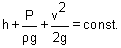
Turbulence can be avoided by incorporating small changes in the design of gating system. The sharp changes in the flow should be avoided to smooth changes. The gating system must be designed in such a way that the system always runs full with the liquid metal. The most important things to remember in designing runners and gates are to avoid sharp corners. Any changes in direction or cross sectional area should make use of rounded corners.
To avoid the aspiration the tapered sprues are designed in the gating systems. A sprue tapered to a smaller size at its bottom will create a choke which will help keep the sprue full of molten metal.
Types of Gating Systems (Figure18a, 18b)
The gating systems are of two types:
- Pressurized gating system
- Un-pressurized gating system
Pressurized Gating System
- The total cross sectional area decreases towards the mold cavity
- Back pressure is maintained by the restrictions in the metal flow
- Flow of liquid (volume) is almost equal from all gates
- Back pressure helps in reducing the aspiration as the sprue always runs full
- Because of the restrictions the metal flows at high velocity leading to more turbulence and chances of mold erosion
Un-Pressurized Gating System
- The total cross sectional area increases towards the mold cavity
- Restriction only at the bottom of sprue
- Flow of liquid (volume) is different from all gates
- aspiration in the gating system as the system never runs full
- Less turbulence
Fig 18a : Pressurized Gating System
Fig 18b : Un-Pressurized Gating System
Riser
Riser is a source of extra metal which flows from riser to mold cavity to compensate for shrinkage which takes place in the casting when it starts solidifying. Without a riser heavier parts of the casting will have shrinkage defects, either on the surface or internally.
Risers are known by different names as metal reservoir, feeders, or headers.
Shrinkage in a mold, from the time of pouring to final casting, occurs in three stages.
- during the liquid state
- during the transformation from liquid to solid
- during the solid state
First type of shrinkage is being compensated by the feeders or the gating system. For the second type of shrinkage risers are required. Risers are normally placed at that portion of the casting which is last to freeze. A riser must stay in liquid state at least as long as the casting and must be able to feed the casting during this time.
Functions of Risers
- Provide extra metal to compensate for the volumetric shrinkage
- Allow mold gases to escape
- Provide extra metal pressure on the solidifying mold to reproduce mold details more exact
Design Requirements of Risers
-
Riser size: For a sound casting riser must be last to freeze. The ratio of (volume / surface area)2 of the riser must be greater than that of the casting. However, when this condition does not meet the metal in the riser can be kept in liquid state by heating it externally or using exothermic materials in the risers.
-
Riser placement: the spacing of risers in the casting must be considered by effectively calculating the feeding distance of the risers.
-
Riser shape: cylindrical risers are recommended for most of the castings as spherical risers, although considers as best, are difficult to cast. To increase volume/surface area ratio the bottom of the riser can be shaped as hemisphere.