Lecture 1
Introduction
The amount of material, a company has in stock at a specific time is known as inventory or in terms of money it can be defined as the total capital investment over all the materials stocked in the company at any specific time. Inventory may be in the form of,
- raw material inventory
- in process inventory
- finished goods inventory
- spare parts inventory
- office stationary etc.
As a lot of money is engaged in the inventories along with their high carrying costs, companies cannot afford to have any money tied in excess inventories. Any excessive investment in inventories may prove to be a serious drag on the successful working of an organization. Thus there is a need to manage our inventories more effectively to free the excessive amount of capital engaged in the materials.
Why Inventories?
Inventories are needed because demand and supply can not be matched for physical and economical reasons. There are several other reasons for carrying inventories in any organization.
-
To safe guard against the uncertainties in price fluctuations, supply conditions, demand conditions, lead times, transport contingencies etc.
-
To reduce machine idle times by providing enough in-process inventories at appropriate locations.
-
To take advantages of quantity discounts, economy of scale in transportation etc.
-
To decouple operations i.e. to make one operation's supply independent of another's supply. This helps in minimizing the impact of break downs, shortages etc. on the performance of the down stream operations. Moreover operations can be scheduled independent of each other if operations are decoupled.
-
To reduce the material handling cost of semi-finished products by moving them in large quantities between operations.
-
To reduce clerical cost associated with order preparation, order procurement etc.
Inventory Costs
In order to control inventories appropriately, one has to consider all cost elements that are associated with the inventories. There are four such cost elements, which do affect cost of inventory.
-
Unit cost: it is usually the purchase price of the item under consideration. If unit cost is related with the purchase quantity, it is called as discount price.
-
Procurement costs: This includes the cost of order preparation, tender placement, cost of postages, telephone costs, receiving costs, set up cost etc.
-
Carrying costs: This represents the cost of maintaining inventories in the plant. It includes the cost of insurance, security, warehouse rent, taxes, interest on capital engaged, spoilage, breakage etc.
-
Stockout costs: This represents the cost of loss of demand due to shortage in supplies. This includes cost of loss of profit, loss of customer, loss of goodwill, penalty etc.
If one year planning horizon is used, the total annual cost of inventory can be expressed as:
Total annual inventory cost = Cost of items + Annual procurement cost + Annual carrying cost + Stockout cost
Variables in Inventory Models
D = Total annual demand (in units)
Q = Quantity ordered (in units)
Q* = Optimal order quantity (in units)
R = Reorder point (in units)
R* = Optimal reorder point (in units)
L = Lead time
S = Procurement cost (per order)
C = Cost of the individual item (cost per unit)
I = Carrying cost per unit carried (as a percentage of unit cost C)
K = Stockout cost per unit out of stock
P = Production rate or delivery rate
dl = Demand per unit time during lead time
Dl = Total demand during lead time
TC = Total annual inventory costs
TC* = Minimum total annual inventory costs
Number of orders per year = 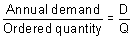
Total procurement cost per year = S.D / Q
Total carrying cost per year = Carrying cost per unit * unit cost * average inventory per cycle

Cost of items per year = Annual demand * unit cost
= D.C
Total annual inventory cost (TC) = 
The objective of inventory management team is to minimize the total annual inventory cost. A simplified graphical presentation in which cost of items, procurement cost and carrying cost are depicted is shown in Figure 1 . It can be seen that large values of order quantity Q result in large carrying cost. Similarly, when order quantity Q is large, fewer orders will be placed and procurement cost will decrease accordingly. The total cost curve indicates that the minimum cost point lies at the intersection of carrying cost and procurement cost curves.
Inventory Operating Doctrine
When managing inventories, operations manager has to make two important decisions:
-
When to reorder the stock (i.e. time to reorder or reorder point)
-
How much stock to reorder (i.e. order quantity)
Reorder point is usually a predetermined inventory level, which signals the operations manager to start the procurement process for the next order. Order quantity is the order size.