Lecture 1
Project Management
A project is a well defined task which has a definable beginning and a definable end and requires one or more resources for the completion of its constituent activities, which are interrelated and which must be accomplished to achieve the objectives of the project. Project management is evolved to coordinate and control all project activities in an efficient and cost effective manner. The salient features of a project are:
- A project has identifiable beginning and end points.
- Each project can be broken down into a number of identifiable activities which will consume time and other resources during their completion.
-
A project is scheduled to be completed by a target date.
- A project is usually large and complex and has many interrelated activities.
- The execution of the project activities is always subjected to some uncertainties and risks.
Network Techniques
The network techniques of project management have developed in an evolutionary way in many years. Up to the end of 18th century, the decision making in general and project management in particular was intuitive and depended primarily on managerial capabilities, experience, judgment and academic background of the managers. It was only in the early of 1900's that the pioneers of scientific management, started developing the scientific management techniques. The forerunner to network techniques, the Gantt chart was developed, during world war I, by Henry L Gantt, for the purpose of production scheduling. An example of Gantt chart is shown in Figure 1. The Gantt chart was later modified to bar chart ( Figure 2 ), which was used as an important tool in both the project and production scheduling. The bar charts, then developed into milestone charts ( Figure 3 ), and next into network techniques (such as CPM and PERT).
Network Construction
A network is the graphical representation of the project activities arranged in a logical sequence and depicting all the interrelationships among them. A network consists of activities and events.
Activity
An activity is a physically identifiable part of a project, which consumes both time and resources. Activity is represented by an arrow in a network diagram ( Figure 4 ). The head of an arrow represents the start of activity and the tail of arrow represents its end. Activity description and its estimated completion time are written along the arrow. An activity in the network can be represented by a number of ways: (i) by numbers of its head and tail events (i.e. 10-20 etc.), and (ii) by a letter code (i.e. A, B etc.). All those activities, which must be completed before the start of activity under consideration, are called its predecessor activities. All those activities, which have to follow the activity under consideration, are called its successor activities ( Figure 5 ). An activity, which is used to maintain the pre-defined precedence relationship only during the construction of the project network, is called a dummy activity. Dummy activity is represented by a dotted arrow and does not consume any time and resource ( Figure 6 ). An unbroken chain of activities between any two events is called a path.
Event
An event represents the accomplishment of some task. In a network diagram, beginning and ending of an activity are represented as events. Each event is represented as a node in a network diagram. An event does not consume any time or resource. Each network diagram starts with an initial event and ends at a terminal event. Each node is represented by a circle ( Figure 7) and numbered by using the Fulkerson's Rule. Following steps are involved in the numbering of the nodes:
-
The initial event, which has all outgoing arrows and no incoming arrow, is numbered as 1.
-
Delete all the arrows coming out from the node just numbered (i.e. 1). This step will create some more nodes (at least one) into initial events. Number these events in ascending order (i.e. 2, 3 etc.).
-
Continue the process until the final or terminal node which has all arrows coming in, with no arrow going out, is numbered.
An illustration of Fulkerson's Rule of numbering the events is shown in Figure 8 . As a recommendation it must be noted that most of the projects are liable for modifications, and hence there should be a scope of adding more events and numbering them without causing any inconsistency in the network. This is achieved by skipping the numbers (i.e. 10, 20, 30…).
Rules for drawing network diagram
Rule 1: Each activity is represented by one and only one arrow in the network.
Rule 2: No two activities can be identified by the same end events ( Figure 9 ).
Rule 3: Precedence relationships among all activities must always be maintained.
Rule 4: Dummy activities can be used to maintain precedence relationships only when actually required. Their use should be minimized in the network diagram ( Figure 10 ).
Rule 5: Looping among the activities must be avoided( Figure11 ).
CPM and PERT
The CPM (critical path method) system of networking is used, when the activity time estimates are deterministic in nature. For each activity, a single value of time, required for its execution, is estimated. Time estimates can easily be converted into cost data in this technique. CPM is an activity oriented technique.
The PERT (Project Evaluation and Review Technique) technique is used, when activity time estimates are stochastic in nature. For each activity, three values of time (optimistic, most likely, pessimistic) are estimated. Optimistic time (to) estimate is the shortest possible time required for the completion of activity. Most likely time (tm) estimate is the time required for the completion of activity under normal circumstances. Pessimistic time (tp) estimate is the longest possible time required for the completion of activity. In PERT β-distribution is used to represent these three time estimates (Figure 12). As PERT activities are full of uncertainties, times estimates can not easily be converted in to cost data. PERT is an event oriented technique. In PERT expected time of an activity is determined by using the below given formula:
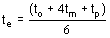
The variance of an activity can be calculated as:
