Ashby Process of including the Shape Factor in MPI
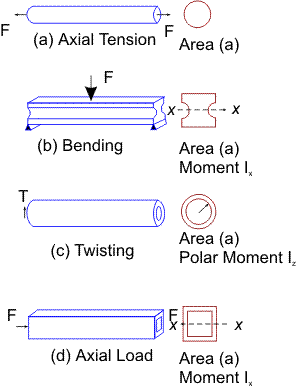
In general a mechanical element carries either of the four types of loading – axial tensile load,
axial compressive load, flexure and torsion.
As structural members we refer
– ‘Ties’ are designed to carry tensile axial loads
– ‘Beams/Frames’ are designed to resist flexure
– ‘Columns’ and ‘Struts’ are designed to carry compressive load
– While ‘shafts’ are designed to carry torsional loads
Accordingly, there should be four types of shape factors for each of these elements.
However, the axial stiffness of a tie rod is independent of the shape of the rod – it only depends
on the total cross-sectional area. Remember K = AE/L in this case. Hence, we can use only three corrective shapefactors
against bending, compression and torsion.
Similar to stiffness, from the strength point of view as well we can have three shape-factors – hence, in all, there are six key shape
factors which we should take care of while choosing both shape and material to fulfill the
design objectives.
|