Subgrid-Scale Closure
The term τij in Equation (33.6) is the contribution of small scales to the large scale transport equation. This term has to be suitably approximated and a modeling strategy will be described herein.
Standard Subgrid-Scale Model
The standard subgrid scale model is briefly described here referred to as Smagorinsky (1963) model. If the filter discussed earlier is applied to the Navier-Stokes equations, subgrid scale stresses will assume the form
 |
(33.8) |
where, the overbar represents the filter operator. These stresses are similar to the classical Reynolds stresses that result from time or ensemble averaging of the advection fluxes, but differ in that they are consequences of special averaging and go to zero if the filter width Δ goes to zero. The most commonly used subgrid scale models are based on the gradient transport hypothesis, which correlates τij to the large-scale strain-rate tensor
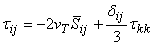 |
(33.9) |
where  and and  is given by is given by
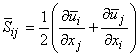 |
(33.10) |
Lilly (1967) like Smagorinsky proposed an eddy-viscosity proportional to the local large-scale deformation:
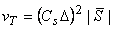 |
(33.10) |
Here Cs is a constant (known as Smagorinsky constant); the filter width Δ is the characteristic length-scale of the resolved eddies, and 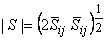 . .
Finding the correct value of Cs is the real challenge of LES. Arising out of several refined theories and practical experiences (Rogallo and Moin, (1984), it is found that Cs lies in the range of 0.07 and 0.21. The crucial point here is the relationship between  and the inertial range spectrum, E(k). If the filter is defined by a numerical approximation scheme, then the scheme has an influence on the magnitude of Cs . Thus, the value of Cs is not universal in LES. In case of anisotropic resolution (different grid widths Δx , Δy and Δz in the different co-ordinate directions), the geometry of the resolution has to be accounted for and the complete approach in this direction is that described by Schumann (1975) and Grotzbach (1986). and the inertial range spectrum, E(k). If the filter is defined by a numerical approximation scheme, then the scheme has an influence on the magnitude of Cs . Thus, the value of Cs is not universal in LES. In case of anisotropic resolution (different grid widths Δx , Δy and Δz in the different co-ordinate directions), the geometry of the resolution has to be accounted for and the complete approach in this direction is that described by Schumann (1975) and Grotzbach (1986).
|