One-Equation Model
This is a very popular model used widely for external aerodynamic flows. Spalart and Allmaras (1992) have developed one equation model, which is designed specifically for aerospace applications involving wall-bounded flows. The Reynolds stresses are given by
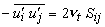 |
(27.1) |
The eddy viscosity vt is given by
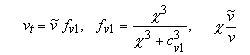 |
(27.2) |
 is the molecular viscosity, is the molecular viscosity,  obeys the transport equation obeys the transport equation

|
|
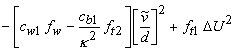 |
(27.3) |
Here
 |
(27.4) |
where S is the magnitude of the vorticity, and d is the distance to the closest wall. The function fw is
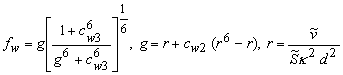 |
(27.5) |
For large r, fw reaches a constant, so large values of r can be truncated to 10 or so. The wall boundary condition is  . In the freestream 0 is best, provided numerical errors do not push to negative values near the edge of the boundary layer (the exact solution cannot go negative). Values below /10 will be acceptable; the same applies to the initial condition. . In the freestream 0 is best, provided numerical errors do not push to negative values near the edge of the boundary layer (the exact solution cannot go negative). Values below /10 will be acceptable; the same applies to the initial condition.
In some codes a portion of the solid surface, typically the fuselage, is treated with a free-slip condition while another portion, typically the wing, is treated with a no-slip condition. For , the appropriate condition on the free-slip surface is a Neumann condition (zero normal derivative). In addition, the free-slip wall points are not included in the search when d is computed for the field points.
The function ft2 is
 |
(27.6) |
The trip function ft1 is as follows. The quantity dt is the distance from the field point to the trip, which is on a wall, wt is the wall vorticity at the trip, and ΔU is the difference between the velocity at the field point and that at the trip. Then gt = min (0.1, ΔU / wtδ xt where δxt is the grid spacing along the wall at trip, and
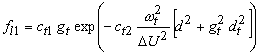 |
(27.7) |
The constants are cb1 = 0.1355, σ = 2/3, cb2 = 0.622,  = 0.41, cw1 = cb1/k2 + (1 + cb2 )/σ , cw2 = 0.3, cw3 = 2, cv1 = 7.1, ct1 = 1, ct2 = 2, ct3 = 1.2 and ct4 = 0.5. = 0.41, cw1 = cb1/k2 + (1 + cb2 )/σ , cw2 = 0.3, cw3 = 2, cv1 = 7.1, ct1 = 1, ct2 = 2, ct3 = 1.2 and ct4 = 0.5.
The model has demonstrated good results for boundary layer flows subject to adverse pressure gradients. It performs well in the near wake and appears to be a good candidate for more complex flows.
|