| |
14.1 Specifications of the Problem
We shall develop the computer code for the bar shown in Fig. 14.1.
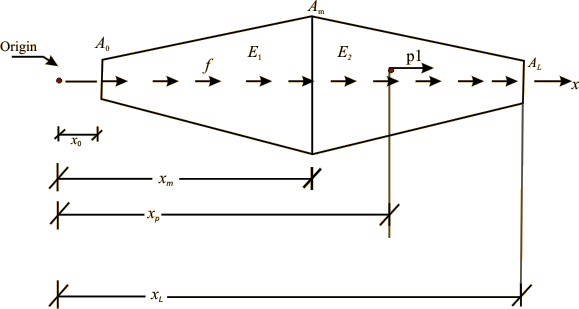
Figure 14.1 Geometric, Material and Force Specifications of the Bar
The specifications of the bar are as follows :
- Geometry : The bar has double taper as shown in the figure. At there is a change in the taper. The area of cross-section can be expressed by the following relations:
 |
(14.1) |
where

|
(14.2) |
 |
(14.3) |
Here,  is the area of cross- section at the left end is the area of cross- section at the left end  , ,  is the area of cross-section at the right end is the area of cross-section at the right end  and and  is the area of cross-section at the point of change of the taper is the area of cross-section at the point of change of the taper  . .
- Material : The bar consists of two materials. The change in material takes place at
 Therefore, the young's modulus of the material can be expressed as : Therefore, the young's modulus of the material can be expressed as :
 |
(14.4) |
 |
(14.5) |
Here,  is the Young's modulus of the left part of the bar upto is the Young's modulus of the left part of the bar upto  and and  is the Young's modulus of the remaining bar. is the Young's modulus of the remaining bar.
- Force : The bar is subjected to two types of forces :
(i) distributed axial force f which varies quadratically with x :
 |
(14.6) |
where  , ,  and and  are constants. are constants.
(ii) point force  at at  . .
- Boundary Conditions : The boundary conditions at either end could be Dirichlet type, Neumann type or Spring type. Thus, we can have the following boundary conditions :
 |
(14.7) |
or
 |
(14.8) |
or
 , at , at  |
(14.9) |
 , , |
(14.10) |
or
 , , |
(14.11) |
or
 , , |
(14.12) |
Here, the specified displacements  and and  are considered positive if they are along positive x-direction. Similarly, the specified axial forces Q and P are considered positive if they are tensile. In the boundary conditions (14.9) and (14.12), are considered positive if they are along positive x-direction. Similarly, the specified axial forces Q and P are considered positive if they are tensile. In the boundary conditions (14.9) and (14.12),  and and  are the spring stiffnesses. Further, the initial spring deflections are the spring stiffnesses. Further, the initial spring deflections  and and  are considered positive if they are compressive. are considered positive if they are compressive.
|