Compare the solutions obtained by the stream function-vorticity method with those presented in this chapter for the following problems:
(a) Developing flow in a parallel plates channel;
(b) Flow past a square cylinder (Re < 200)
(c) Flow past a periodic array of square cylinders.
Apply MAC method to solve the share driven cavity flow problem shown in Figure 36.2. Take a grid size of 51 ×51 and solve the flow equations for Re=400
 driven by a constant (but as yet undetermined) pressure gradient. For definiteness, flow in a parallel plate channel can be considered.
  direction may be written as



 - momentum equation on a grid (in spherical polar coordinate) using a weighted average scheme.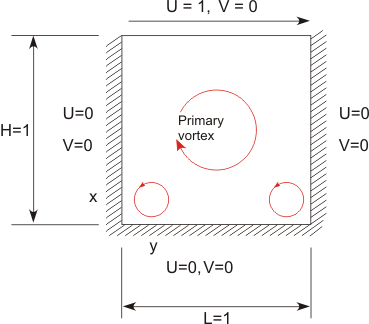

 is the convective flux at the point
 has been defined.
  is the diffusion coefficient. Both
  and
and  and at
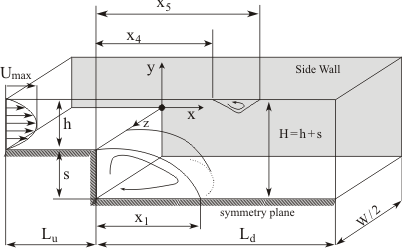
 for the Reynolds numbers of 200, 300, and 400. The Reynolds number is given by