Numerical Stability Considerations
For accuracy, the mesh size must be fine enough to resolve the expected spatial variation in all dependent variables.
Once a mesh has been chosen, the choice of the time increment is governed by two restrictions, namely, the Courant-Fredrichs-lewy (CFL) condition and the restriction on the basis of grid-Fourier numbers. According to the CFL condition, material connot move through more than one cell in one time step, because the difference equations assume fluxes only between the adjacent cells.
Therefore, the time increment must satisfy the inequality.
where the minimum is with respect to every cell in the mesh. Typically,  is chosen equal to one-fourth to one-third of the minimum cell transit time. When the viscous diffusion terms are more important, the condition necessary to ensure stability is dictated by the restriction on the Grid-Fourier numbers, which result in is chosen equal to one-fourth to one-third of the minimum cell transit time. When the viscous diffusion terms are more important, the condition necessary to ensure stability is dictated by the restriction on the Grid-Fourier numbers, which result in
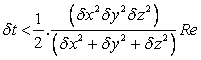
in dimensional form. After non-dimensionilization, this leads to
The final  for each time increment is the minimum of the for each time increment is the minimum of the  's obtained from equations (35.1) and (35.3) 's obtained from equations (35.1) and (35.3)
The last quantity needed to ensure numerical stability is the upwind parameter  . In general, . In general,  should be slightly larger than the maximum value of should be slightly larger than the maximum value of  or or  occurring in the mesh, that is, occurring in the mesh, that is,
As a ready prescription, a value between 0.2 and 0.4 can be used for  . If . If  is too large, an unnecessary amount of numerical diffusion (artificial viscosity) will be introduced. is too large, an unnecessary amount of numerical diffusion (artificial viscosity) will be introduced.
|