Boundary Conditions
So far we have not discussed the boundary conditions. However, they are imposed by setting appropriate velocities in the fictitious cells surrounding the physical domain (Figure 34.1).
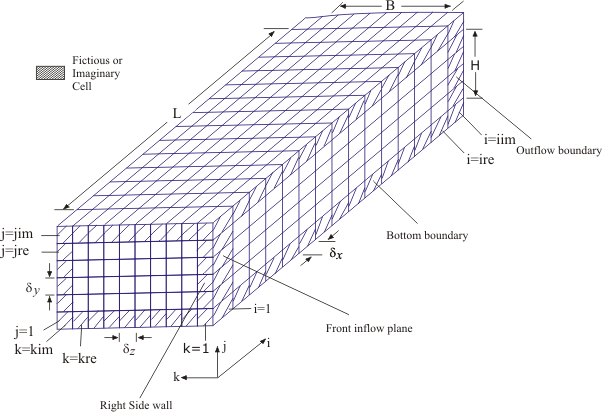
Figure 34.1; Boundary conditions and fictitious boundary cells
Consider, for example, the bottom boundary of the computational (physical) mesh. If this boundary is to be a rigid no-slip wall, the normal velocity on the wall must be zero and the tangential velocity components should also be zero. Here we consider a stationary wall. With reference to the Figure 34.1, we have
|
for i=2 to ire
and k=2 kre
|
If the right side of the wall is a free-slip (vanishing shear) boundary, the normal velocity must be zero and the tangential velocities should have no normal gradient.
|
for i=2 to ire
and j =2 to jre
|
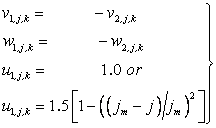
If the front plane is provided with inflow boundary conditions, it should be specified properly. Any desired functional relationship may be recommended. Generally, normal velocity components are set to zero and a uniform or parabolic axial velocity may be deployed. Hence with reference to Fig. 34.1, we can write
|
for  to jre to jre
and  to kre to kre |
where  is the horizontal midplane. is the horizontal midplane.
|