ROTATION
A two-dimensional rotation is applied to an object by repositioning it along a circular path in the x-y plane. When we generate a rotation we get a rotation angle (θ) and the position about which the object is rotated (xr , yr) this is known as rotation point or pivot point. The transformation can also be described as a rotation about rotation axis that is perpendicular to x-y plane and passes through the pivot point. Positive values for the rotation angle define counter-clockwise rotations about the pivot point and the negative values rotate objects in the clockwise direction.
Suppose the pivot point be at origin, to understand the relationship between angular and coordinate points of original and transformed position lets look at the figure below:
Here,
r
- constant distance of the point from the origin.
Φ
- original angular position of the point from the horizontal
θ
- rotation angle
we can express the transformation by the following equations

we know the coordinate of x and y in polar form

on expanding and equating we get

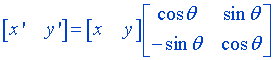
The same equations we can write in matrix form as

Where the rotation matrix R is
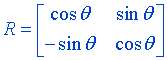
Hence it is