Color CRT Monitors
The beam penetration method for displaying color pictures has been used with random-scan monitors. Two layers of phosphor, usually red and green, are coated on to theinside of the CRT screen, and the displayed color depends on how far the electron beam penetrates into the phosphor layers.
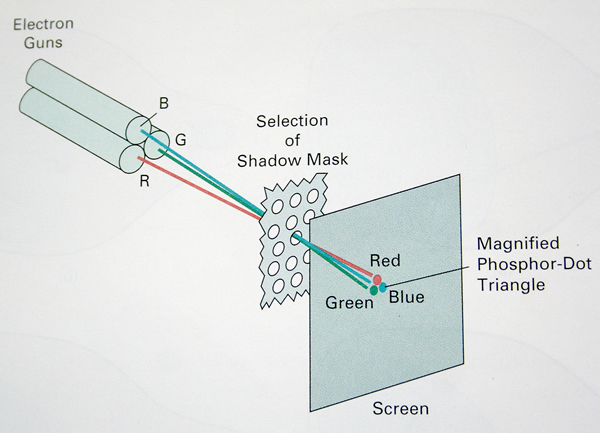
Shadow-mask methods are commonly used in raster-scan systems (including color TV) because they produce a much wider range of color than the beam penetration method. A shadow-mask CRT has three phosphor color dots at each pixel position. One phosphor dot emits a red light, another emits a green light, and the third emits a blue light. This type of CRT has three electron guns, one for each color dot, and a shadow- mask grid just behind the phosphor –coated screen.Fig.below illustrates the delta-delta shadow-mask method, commonly used in color CRT systems. The three electron beam are deflected and focused as a group onto the shadow mask, which contains a series of holes aligned with the phosphor-dot patterns. When the three beams pass through a hole in the shadow mask, they activate a dot triangle, which appears as a small color spot the screen the phosphor dots in the triangles are arranged so that each electron beam can activate only its corresponding color dot when it passes through the shadow mask.