Moderation
- The energy is reduced by collision process and bulk of the slowing is through elastic collision process.
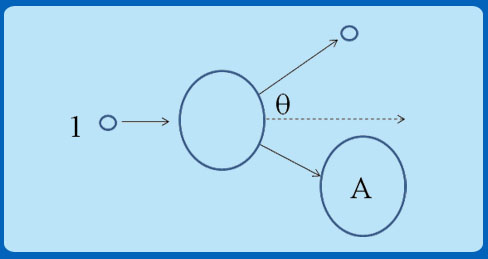
- The typical scattering process is shown below.
- In the figure a neutron of mass 1 (amu) is shown colliding with a nucleus of mass A (amu) which is originally at rest. After the collision process they move in different directions as shown.
- When angle of scattering is 0 (θ = 0), there is no energy loss.
- When θ = 180, there is maximum energy loss.
- We shall discuss about these later in the course.
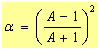
- For a neutron with energy E0, colliding with a nucleus of mass A, the minimum energy a neutron can attain can be shown to be αE0, where
The value of mean energy loss per collision is summarised in the following table.
Element |
A |
α |
|
H |
1 |
0 |
0.500 |
D |
2 |
0.111 |
0.444 |
Be |
9 |
0.640 |
0.180 |
C |
12 |
0.716 |
0.142 |
U |
238 |
0.983 |
0.008 |
- H as H2O and D as D2O are the most commonly used moderators.
- Gas cooled reactors use C as the moderator.
- Be is used as moderator in some research reactors.
- It may be observed that heavy element such as U is a very poor moderator.
|