Energy from a Nuclear Reaction
- In nuclear reactions, the extractable energy possessed
by a particle is its kinetic energy.
- Hence net energy of a reaction can be defined as the difference of kinetic energy of products and kinetic energy of reactants.
- As the total energy is equal to rest mass energy + kinetic
energy, we can write
E01 + T1 + E02 + T2 = E03 + T3 + E04 + T4.
- Thus energy from a reaction, also called its Q value, can
be written as
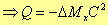
Q = T3 + T4 -T1- T2 = E01 + E02 - E03 - E04.
- The masses expressed in the previous equation are the
rest masses of the participating nuclei.
- However, since Z1 + Z2 = Z3 + Z4 , We can add the
respective masses of electrons to products and reactants and can conclude that
Where, Mx, are the masses of neutral atoms that can be measured by a mass spectrometer.
- A website where all the masses are tabulated is given
below. The tabluated masses can be used to calculate the Q-value.
Atomic Weights and Isotopic Compositions for All Elements
| Z |
Isotope |
A |
Mass (amu) |
Isotope Composition |
Atomic Weight |
1 |
H |
1 |
1.007 825 032 1(4) |
99.9885(70) |
1.007 94(7) |
D |
2 |
2.014 101 778 0(4) |
0.0115(70) |
|
T |
3 |
3.016 049 2675(11) |
|
|
2 |
He |
3 |
3.016 029 309 7(9) |
0.000 137(3) |
4.002 602(2) |
4 |
4.002 603 2497(10) |
99.999 863(3) |
|
|