| |
Kinetic Energy
- Towards understanding nuclear reactions, first we will define kinetic energy.
- From the theory of relativity, we conclude that mass
and energy are interconvertible.
- The total energy of a particle, whose mass is M can be
written as
- In the above equation C is the velocity of light.
- When a particle is at rest, we can write the energy
possessed by it as the rest mass energy and can be
written as
In the above equation M0 is the rest mass.
- From the theory of relativity, we note that the mass, M,
changes with velocity, V, and this can be represented by
- Now if we would like to extract the energy from a
moving particle by slowing it down to zero velocity,
then the extractable energy shall be
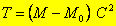
- This we shall define as kinetic energy and denote it as T.
- Thus T is the difference between the total energy and
the rest mass energy.
- Now we will try to connect this to the kinetic energy in
Newtonian Mechanics.
- From Eq. (4) and Definition of T, we can write
- Substituting for M from Eq. (3), we get,
|
if |
 |
|
Thus,  |
- Thus for V << C, the kinetic energy reduces it to the classical Newtonian mechanics definition.
- To decide on a criterion for up to what velocity we can use Newtonian mechanics, consider the case of V = 0.1 C.
- From Eq. (6), we get,
- Thus for V<0.1C, the Newtonian Mechanics is adequate as the results are within 0.75%.
|
|
|
|