-
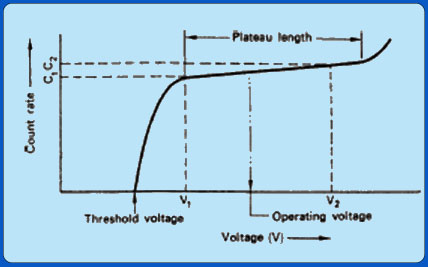
At a characteristic voltage, an avalanche of electrons are formed all over the anode, called “Townsend Avalanche”.
-
At this point the pulse height is constant irrespective of the energy of the radiation that triggers the count.
-
If we define a term called amplification (A) that represents the ratio of the total ion-electron pairs collected to the number primarily formed by the radiation, its value in GM region reaches ~ 106.
-
The value of A in the Ionisation chamber plateau is one.
-
It gradually increases in the proportional region.
-
The reason for the pulse height being independent of the initial number of ion-electron pair is that the amplification is so high that it saturates the detector, cripples the electric field and prevents further multiplication.
-
This plateau is called the GM Plateau.
-
It has been argued that as the voltage is increased, the avalanche spreads radially and increases the count rate or the pulse height, though the increase is small.
-
Thus, the plateau has a slight positive slope.
-
As the voltage is increased, at a characteristic voltage, the gas breaks down and goes into a continuous discharge region.
-
The detector will fail if taken to continuous discharge region.
-
The slope of the GM Plateau is defined as a percentage increase in count rate per 100 V.
-
It is given as

.