| |
Cell Biology
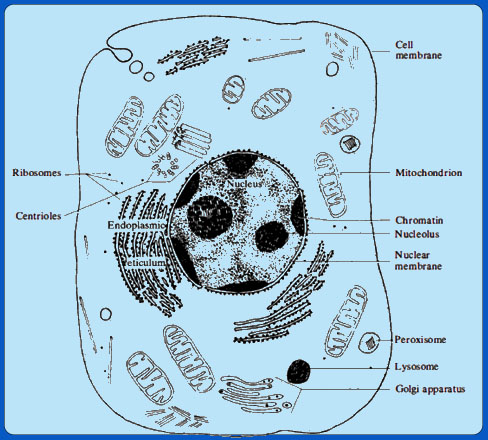 |
- One of the important constituent of the cell is chromatin. Its role shall be discussed later.
- Cells multiply by cell division. The division of somatic cell is called Mitosis.
- Every cell follows a cycle. There are four stages in this cycle. These are denoted by M-G1-S-G2. G1 and G2 refer to time gaps between the Mitosis and Synthesis of DNA phases.
- The chromatin is normally a tangled bunch strands of DNA (De-oxyribose Nucleic Acid) molecules and some nuclear proteins.
- During Mitosis, the chromatin untangles itself and becomes distinct set of bundles called Chromosomes.
- In humans there are 46 chromosomes in somatic cells and 23 chromosomes in germ cells.
- During Mitosis, each chromosome replicates itself.
- Certain segments of DNA molecules in chromosomes provide coding that control the synthesis of proteins. These are called genes.
- Changes brought about in genetic codes can result in inheritable changes.
|
|
| |
| |
| |
| |
| |
|
|
