| |
Definitions |
- We had seen previously in the course that the intensity of neutrons in a beam was defined as the number of neutrons crossing a plane per unit area and unit time and this was shown to be
|
|
- Since the beam travels in the same direction unless it is absorbed, the problem is a scalar as there is no change of direction is involved.
- However, when we deal with neutrons in a reactor, they are born at different places and travel in different directions.
- Further their directions are modified due to the process of scattering.
- To predict the neutron population density variation in a reactor we need a more complex treatment.
- It will be practically impossible to track every neutron and study its motion as there are very large number of neutrons present in the system.
- To handle this problem in a simple manner, the concept of diffusion is introduced.
- Before we formally look at the concept of diffusion, we shall define a few terms.
- The term Neutron Flux, φ, is defined as the product of neutron density and the speed of the neutron and it is a scalar quantity.
|
|
- Another term Neutron Current, J, is defined as number of neutrons crossing a unit area per unit time in a specific direction.
- J is a vector quantity and shall have components such as Jx, Jy, etc.
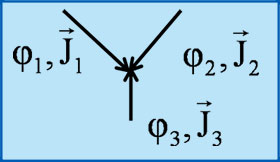
- Consider the case of several beams intersecting at a point as shown in the figure below.
- At the point of intersection
|
|
- When several beams cross, it is easy to visualise that, the former is a scalar sum, while the latter is a vector addition.
- If all the neutrons travel in the same direction as in a single beam, both φ and J are identical in a non scattering system.
|
|
|
|