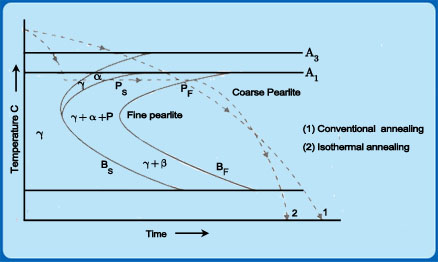
Isothermal annealing
Isothermal annealing consists of four steps. The first step is heating the steel components similar as in the case of full annealing. The second step is slightly fast cooling from the usual austenitizing temperature to a constant temperature just below A1. The third step is to hold at this reduced temperature for sufficient soaking period for the completion of transformation and the final step involves cooling the steel component to room temperature in air. Figure 4.7.3 depicts the heat treatment cycles of full annealing and isothermal annealing. The terms α, γ, P, PS and PF refer to ferrite, austenite, pearlite, pearlite starting and pearlite finish, respectively.
Isothermal annealing has distinct advantages over full annealing which are given below.
- Reduced annealing time, especially for alloy steels which need very slow cooling to obtain the required reduction in hardness by the full annealing.
- More homogeneity in structure is obtained as the transformation occurs at the same time throughout the cross section.
- Improved machinability and surface finish is obtained after machining as compared to that of the full annealed components.
Isothermal annealing is primarily used for medium carbon, high carbon and some of the alloy steels to improve their machinability. |