| |
| Applications of Adhesive Bonded Joints |
- Bonding of metal to non-metals especially plastics is the major application of adhesive bonding.
- Used as an alternative to riveting for aircraft structures.
- Widely applicable in fastening of stiffeners to the aircraft skin and in assembling honeycomb structures in aircraft.
- Using extensively in the fabrication of aircraft internal structures and providing the smooth surface for supersonic planes.
- Useful in automobile industry for attaching brake lining to shoes, automatic transmission bands, and stiffeners.
- Find applications in the fabrication of railway coaches, boats, refrigerators, storage tanks, and microwave reflectors for radar and space communications.
|
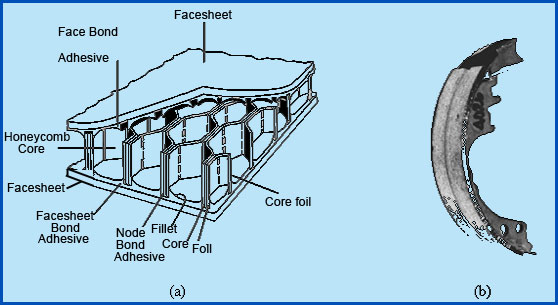 |
| Figure 4.5.1 Some typical adhesive bonded structures (a) honey comb Panel structure,
(b) automotive brake lining [2,3]. |
Design Recommendations for Adhesive Joints
- As adhesive bonds resist shear, tensile, and compressive forces better than cleavage or peel, design assemblies which will be subjected to the former type of applications [Figure 4.5.2(a)].
- The width of the joint overlap is more important than the joint length. Bond strength is proportional to the joint area only in the case of compressive and tensile forces. In assemblies loaded under shear forces, the stresses tend to get concentrated at the joints end [Figure 4.5.2(b)].
- Difference in the thermal expansion coefficient of the materials leads to shear stresses when exposed to thermal loading. Hence to reduce the same the adhesive should have an expansion coefficient midway between that of the adherents. Fillers are often added to an adhesive to control its coefficient of expansion.
- The surface preparation is a major step in adhesive bonding. Both the surfaces of the bonded parts should be cleaned properly to get a sound joint. Vapour degreasing and solvent wiping techniques may be applied to clean the surfaces. Smooth surfaces are preferred as these are more easily wet by spreading liquid adhesive.
- Simple butt joints should be used only when fairly large bonded surfaces are involved and when cleavage stresses cannot be anticipated [Figure 4.5.3].
- Design modifications to minimize cleavage stresses in lap joints subjected to tension are shown in Figure 4.5.4.
- Figure 4.5.5 depicts the recommended corner joints for the workpieces of different thicknesses. It is always recommended to choose a design which involves least preparation cost.
- The techniques for adhesive joining of rods and tubes are shown in Figure 4.5.6.
|
|
|
|
