Threaded fasteners include screws, bolts, and machine screws and are widely used to secure parts together. Some of the significant design guidelines are listed below when threaded fasteners are in use for an assembly.
- When strong holding force is not required, screw fasteners may be used to reduce the assembly cost.
- Provide sufficient clearance around the fastener locations to avoid marring or damaging of the workpiece contact surface with the rivets
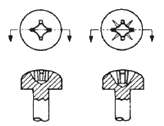
- Various types of screw heads are available [Figure 4.1.2(a)]. Hexagonal head and cross-recess types are preferred as these are less susceptible to driver slippage and marred surfaces.
- When mating parts are susceptible to misalignment in application, machine screws with points that provide a piloting action and avoid cross threading are suggested.
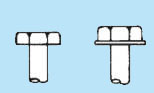
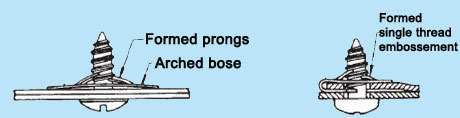
- Screw and washer assemblies are desirable as they reduce assembly cost [Figure 4.1.2(b)].
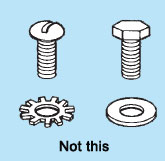
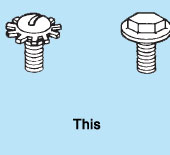
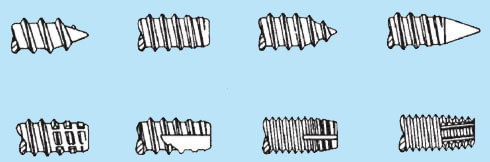
- Self-tapping screws are preferable to conventional screws because they eliminate the need for tapping operations on the parts to be assembled [Figure 4.1.2(c)].
- Use spring nuts whenever torque requirement for the intended application is not significant. These types of screws are inexpensive, easier to assemble and stay in place even when it is not engaged [Figure 4.1.2(d)].
- There should be proper allowance for access to the screw fastener by most of the driving and tightening tools.
- Use of slotted nuts and cotter pins should be avoided whenever possible.
- For smaller production quantities it is usually economical to employ separate nuts in comparison to tap screw threads into the base part.
|