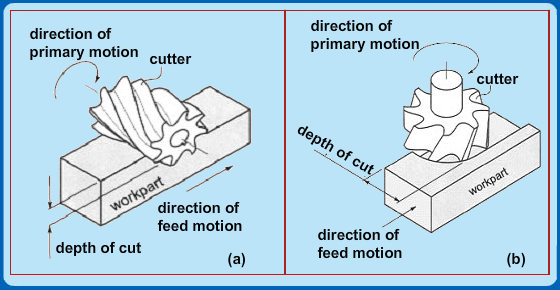
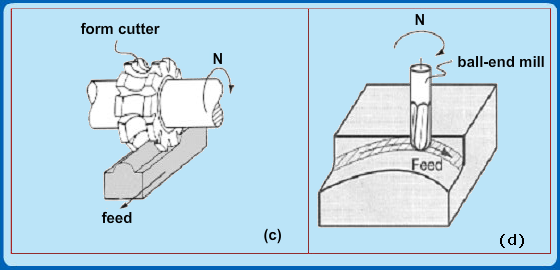
Depending on the orientation and geometry of the milling tool, several varieties of milling operations are possible. In peripheral milling (Figure 3.5.5a), also referred to as plain milling, the axis of the cutter is parallel to the surface being machined, and the operation is performed by the cutting edges on the outside periphery of the tool. The primary motion is the rotation of the tool. The feed is imparted to the workpiece. In face milling (Figure 3.5.5b), the tool is perpendicular to the machined surface. The tool axis is vertical, and machining is performed by the teeth on both the end and the periphery of the face-milling tool. Also, up and down types of milling are available, depending on directions of the tool rotation and feed. End milling is used to produce pockets, key holes by using a tool referred to as the end mill, has a diameter less than the workpiece width. In form milling (Figure 3.5.5c), the cutting edges of the peripheral tool (also referred to as form cutter) have a special profile that is imparted to the workpiece. Tools with various profiles are also available to cut different two-dimensional surfaces. One important application of form milling is in gear manufacturing. Surface contouring (Figure 3.5.5d), is an operation performed by computer controlled milling machines in which a ball-end mill is fed back and forth across the workpiece along a curvilinear path at close intervals to produce complex three-dimensional surfaces. |