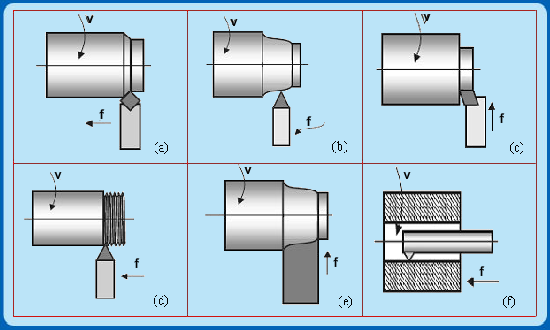
Straight turning is used to reduce the diameter of a part to a desired dimension (Figure 3.5.3 a). The resulting machined surface is cylindrical. Contour turning and Taper turning (Figure 3.5.3b) are performed by employing a complex feed motion using special attachments to a single point turning tool thus creating a contoured shape on the workpiece. Facing (Figure 3.5.3c) is done to create a smooth, flat face perpendicular to the axis of a cylindrical part in an accurate manner. The tool is fed radially or axially to create a flat machined surface. Thread cutting (Figure 3.5.3d) is possible in lathe machine by advancing the cutting tool at a feed exactly equal to the thread pitch. The single-point cutting tool cuts in a helical band, which is actually a thread. The tool point must be ground so that it has the same profile as the thread to be cut. Thread can be both external and internal types. In form turning (Figure 3.5.3e), the shape of the cutting tool is imparted to the workpiece by plunging the tool into the workpiece. In form turning, the cutting tool can be very complex and expensive but the feed will remain linear and will not require special machine tools or devices. Boring (Figure 3.5.3f) is similar to straight turning operation but differs in the fact that it can produce internal surface of revolution, which is often considered to be difficult due to overhanging condition of the tool. |