Module 3 : Selection of Manufacturing Processes
Lecture 4 : Design for Sheet Metal Forming Processes
 
Defects in Deep Drawing

Wrinkling is a major defect in drawing operation. The movement of the blank into the die cavity induces compressive stress in the flange causing wrinkle. This can be reduced by keeping a blank holder under the effect of a holding force. The magnitude of the force has to be controlled as a function of punch travel to minimize wrinkle. Rapture and excess thinning of the cup wall are also some pronounced defects in deep drawing process. Rapture is caused by incorrect draw ratio and improper die and punch design whereas too little die and punch clearance is responsible for the thinning of the cup wall. Failure generally occurs by thinning of the cup wall under high longitudinal stress.

Hydroforming

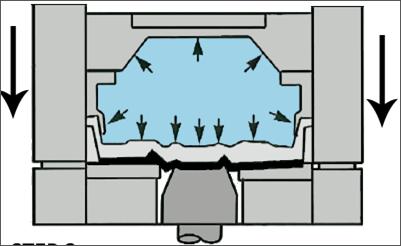
Hydroforming, as shown schematically in figure 3.4.5, is a specialized type of die forming that uses pressurized hydraulic fluid to form typical metallic sheets in to a desired shape with a die cavity. Hydroforming is a cost-effective way of shaping malleable metals such as aluminium or brass into lightweight, structurally stiff and strong pieces. Hydroforming allows complex shapes with concavities to be formed, which would be difficult or impossible with standard solid die stamping. Hydroformed parts can often be made with a higher stiffness-to-weight ratio and at a lower per unit cost than traditional stamped or stamped and welded parts. Virtually all metals capable of cold forming can be hydroformed, including aluminium, brass, carbon and stainless steel, copper and high strength alloys.

Figure 3.4.5  Schematic set-up of Hydroforming process of sheet metal parts [3]