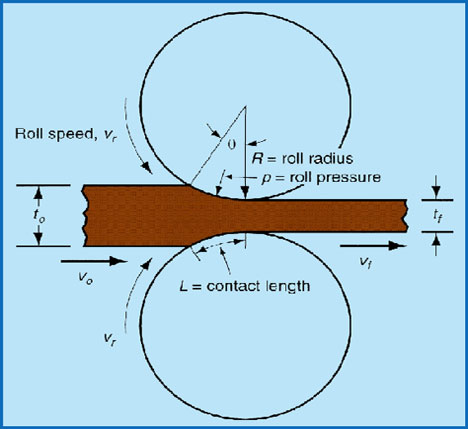
Rolling is a forming operation where cylindrical rolls are used to reduce the cross sectional area of a bar or plate with a corresponding increase in the length. Rolling process is widely used because of high productivity. Figure 3.3.2 depicts schematic set-up of rolling process. Rolling processes are broadly classified by the geometry of the final rolled shape of the workpiece material such as flat rolling that is used to reduce thickness of a rectangular cross‑section, and shape rolling that is used to produce shaped sections such as I-Beam from a square or rectangular cross‑section
Rolling processes are performed both at high temperature (above the recrystallization temperature), which is referred to as Hot Rolling, as well as at room temperature that is referred to as Cold Rolling. Hot Rolling is usually performed when large amount of deformation is required while Cold Rolling is performed for finished sheet and plate stock. Various structural members, plates and sheets as well as pipes are produced by rolling at very high productivity although due to high tooling cost, it is economical for large batch size only. |