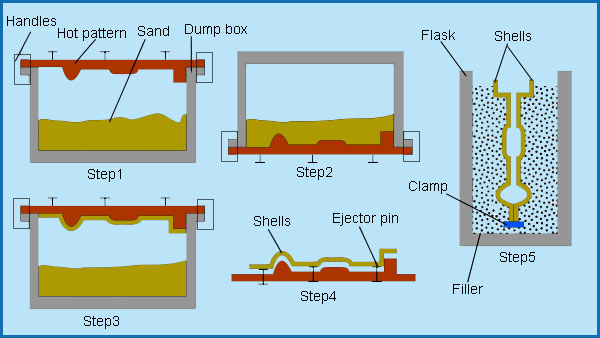
Shell molding is similar to sand casting. Normally a machined pattern of grey iron or aluminum is used in this process. The pattern is heated to 250oC to 260oC and the sand resin mixture is poured over its surface. The heated pattern melts the resin creating bonds between the sand grains. After a dwell period the pattern and sand inverted and extra sand is cleaned off. The mold cavity is now formed by a hardened shell of sand. The mold is then heated in an oven for further curing. The shell thus formed constitutes one half of the mold. Two such halves are placed over one another to make the complete mold. The sands used in shell molding process are usually finer than the same used in sand casting. This process is ideal for complex shaped medium sized parts. Figure 3.2.2 represents the steps of shell mold casting. This method can be employed for making an integrate shapes, thin and sharp corners small projection which are not possible in green sand mold. Subsequent machining operations are also reduced due to more dimensional accuracy.
|