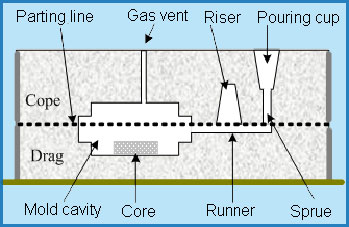
Sand casting is widely used for centuries because of the simplicity of the process. The sand casting process involves the following basic steps: (a) place a wooden or metallic pattern in sand to create a mold, (b) fit in the pattern and sand in a gating system, (c) remove the pattern, (d) fill the mold cavity with molten metal, (e) allow the metal to cool, and (f) break the sand mold and remove the casting. The sand casting process is usually economical for small batch size production. The quality of the sand casting depends on the quality and uniformity of green sand material that is used for making the mold. Figure 3.2.1 schematically shows a two-part sand mold, also referred to as a cope-and-drag sand mold. The molten metal is poured through the pouring cup and it fills the mold cavity after passing through downsprue, runner and gate. The core refers to loose pieces which are placed inside the mold cavity to create internal holes or open section. The riser serves as a reservoir of excess molten metal that facilitates additional filling of mold cavity to compensate for volumetric shrinkage during solidification. Sand castings process provides several advantages. It can be employed for all types of metal. The tooling cost is low and can be used to cast very complex shapes. However sand cast parts offer poor dimensional accuracy and surface finish. |