The hardness is another important mechanical property of engineering material and refers to the resistance of a material against abrasion / scratching / indentation. The hardness of a material is always specified in terms of the particular test that is used to measure the same. For a measure of resistance against indentation, Vickers, Brinell, Rockwell, Knoop hardness tests are common. Alternately, for a measure of resistance against scratch, Mohr’s hardness test is followed. The basic principle used in these testing involves the pressing of a hard material against the candidate material, whose hardness is to be measured. The Brinell hardness (figure 2.1.5) test method consists of indenting the test material with a 10 mm diameter hardened steel or carbide ball subjected to a load of 3000 kg. For softer materials the load can be reduced to 1500 kg or 500 kg to avoid excessive indentation. The full load is normally applied for 10 to 15 seconds in the case of iron and steel and for at least 30 seconds in the case of other metals. The diameter of the indentation left in the test material is measured with a low powered microscope. The Brinell harness number is calculated by dividing the load applied by the surface area of the indentation. The typical Brinell hardness values of some of the commonly used engineering materials are as follows: aluminum – 15, copper – 35, mild steel – 120, austenitic stainless steel – 250, hardened tool steel – 650, and so on. |
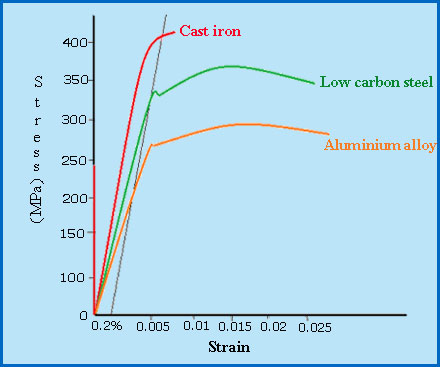
Another important mechanical property of engineering materials is the toughness that provides a measure of a material to withstand shock and the extent of plastic deformation in the event of rupture. Toughness may be considered as a combination of strength and plasticity. One way to measure toughness is by calculating the area under the stress strain curve from a tensile test. The toughness is expressed in Joule to indicate the amount of energy absorbed in the event of failure or rupture. Figure 2.1.6 shows the schematic set-ups of Izod impact test and Charpy impact test. In both the cases, impact loading is applied in notched specimen of predefined dimension. Energy absorbed during the breakage of the specimen is the measure of the toughness. In a similar line, resilience of a material refers to the energy absorbed during elastic deformation and is measured by the area under the elastic portion of the stress – strain curve. Izod and charpy tests are two important methods for evaluating toughness of a material. |