Stresses computed on the basis of the original area of the specimen are often referred to as the conventional or nominal stresses. Alternately, the stresses computed on the basis of the actual area of the specimen provide the so called true stress. Within the elastic limit, the material returns to its original dimension on removal of the load. The elastic modulus is referred to the slope of the stress-strain behavior in the elastic region and its SI unit is conceived as N.m-2. The elastic modulus is also referred to as the constant of proportionality between stress and strain according to Hooke’s Law. Beyond the elastic limit, the materials retains a permanent, irreversible strain (or deformation) even after the load is removed. The modulus of rigidity of a material is defined as the ratio of shear stress to shear strain within the elastic limit. The bulk modulus is referred to the ratio of pressure and volumetric strain within the elastic limit.
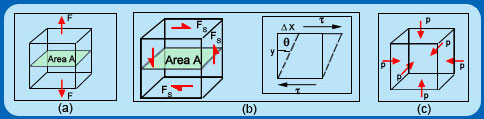
Figure 2.1.3(a) to (c) schematically shows the uniaxial tensile, shear and hydrostatic compression on a typical block of material. When a sample of material is stretched in one direction it tends to get thinner in the other two directions. The Poisson's ratio becomes important to highlight this characteristic of engineering material and is defined as the ratio between the transverse strain (normal to the applied load) and the relative extension strain, or the axial strain (in the direction of the applied load). For an engineering material, the elastic modulus (E), bulk modulus (K), and the shear modulus (G) are related as: G = E/2(1+n) and K = E/3(1-2n), where n refers to the Poisson’s ratio.
 |
|
The strength (SI units: Pa or N/m2) is the property that enables an engineering material to resist deformation under load. It is also defined as the ability of material to withstand an applied load without failure. Based on the typical stress-strain behavior of an engineering material, a few reference points are considered as important characteristics of the material. For example, the proportional limit is referred to the stress just beyond the point where the stress / strain behavior of a material first becomes non-linear. The yield strength refers to the stress required to cause permanent plastic deformation. The ultimate tensile strength refers to the maximum stress value on the engineering stress-strain curve and is often considered as the maximum load-bearing strength of a material. The rupture strength refers to the stress at which a material ruptures typically under bending. Different material behaves differently when subjected to load. Figure 2.1.4 indicates the different in stress strain behavior of typical cast iron, low carbon steel, and aluminum alloy. Cast iron, being a brittle material generates steeper curve than low carbon steel or aluminum alloy. There is no sign of yielding prior to failure, so the yield point has to be found out graphically. The yield point strength in the case of low carbon steel and aluminum alloys can be identified easily.
|
