Chemical properties are the measure of reactivity of a material in the presence of another substance or environment which imposes change in the material composition. These properties are always mentioned in term of the rate of change in its composition. Corrosion rate, oxidation rate, etc. are some of the chemical properties of material.
- Corrosion rate: Corrosion rate is measured in terms of corrosion penetration for given period of time at specific surrounding condition. Corrosion rate is given by length of penetration per unit time. (Units: mm/year)
- Oxidation rate: Oxidation rate is measured in terms of amount of material consumed forming oxide or amount of oxide scale formed for given period of time at specific surrounding temperature. Oxidation rate is given by amount of mass of material lost or thickness of scale formed during oxidation per unit time. (Units: gms/min or μm/min)
|
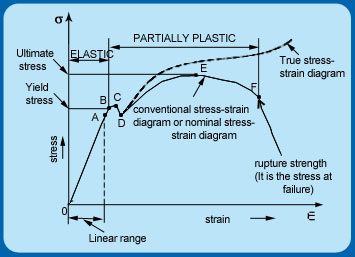
Mechanical properties describe the behavior of material in terms of deformation and resistance to deformation under specific mechanical loading condition. These properties are significant as they describe the load bearing capacity of structure. Elastic modulus, strength, hardness, toughness, ductility, malleability are some of the common mechanical properties of engineering materials. Every material shows a unique behavior when it is subjected to loading. Figure 2.1.2 shows a typical stress-strain curve of C-steel under uniaxial tensile loading. Point ‘A’ indicates the proportional limit. Stress strain behavior is linear only up to this point. Point ‘B’ represents the point at which the material starts yielding. Between point A and B, the stress strain behavior is not linear, though it is in elastic region. Point ‘C’ is referred to the upper yield point. The material behavior after point ‘D’ is highly nonlinear in nature. Point ‘E’ is the maximum stress that the material can withstand and the point ‘F’ schematically indicates the point of rupture. |