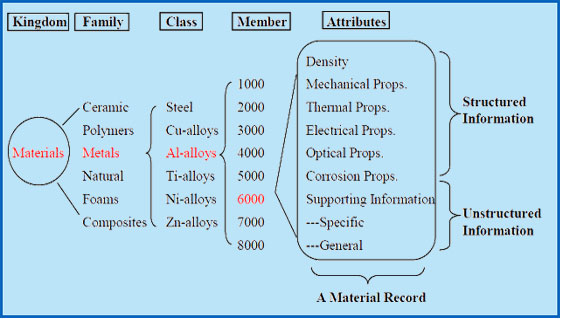
Material property is the identity of material, which describes its state (physical, chemical) and behavior under different conditions. The material properties can be broadly categorized as physical, chemical, mechanical and thermal.
The physical properties define the physical state of material and are independent of its chemical nature. The physical properties of engineering materials include appearance, texture, mass, density, Melting point, boiling point, viscosity, etc. The chemical properties describe the reactivity of a material and are always mentioned in terms of the rate at which the material changes its chemical identity, e.g. corrosion rate, oxidation rate, etc. The mechanical properties describe the resistance against deformation, in particular, under static and dynamic mechanical loading condition. The mechanical properties include elastic modulus, Poisson’s ratio, yield strength and ultimate tensile strength, hardness and toughness, etc. The thermal properties describe material behavior under thermal loading and include thermal conductivity, specific heat, thermal diffusivity, coefficient of thermal expansion, etc. For a given application or service, an engineering material is selected based on a set of appropriate material properties, often referred to as attributes, that would be requisite to sustain various expected loads. Figure 2.1.1 depicts a schematic representation of material family, which is utilized in selection of materials for a target application. |
Physical properties describe the state of material, which is observable or measurable. Color, texture, density, melting point, boiling point, etc. are some of the commonly known physical properties.
- Color: Represents reflective properties of substance
- Density: Amount of mass contained by unit volume of material. The higher the density the heavier is the substance. (SI unit: kg/m3)
- Melting point: Melting point is the temperature at which material changes its state from solid to liquid. (SI units: K)
- Boiling point: Boiling point is the temperature at which material changes its state from liquid to gaseous.(SI units: K)
|