Chapter 4
Distributions
Definition 4.2 The probability measure $ \mu$ is called the distribution or law of the random variable $ X$ and we denote it by $ {\mathcal L}(X)$.
Note that if $ F$ is the distribution function of $ X$, then
$\displaystyle F(x) \ = \ {\mathcal L}(X)(-\infty, \, x].$
 
Example 4.0.26   Consider the probability space $ (\Omega, \ {\mathcal F}, \ P)$ given by
$\displaystyle \Omega \ = \ \{HH, \, HT, \, TH, \, TT\},
$
$\displaystyle {\mathcal F} \ = \ {\mathcal P}(\Omega),
$
$\displaystyle P\{HH\} \ = \ P\{HT\} \ = \ P\{TH\} \ = \ P\{TT\} \ = \ \frac{1}{4}.
$
Define $ X : \Omega  \to \mathbb{R}$ as follows. For $ \omega \in \Omega$,
$ X(\omega)$ = number of heads in $ \omega$.
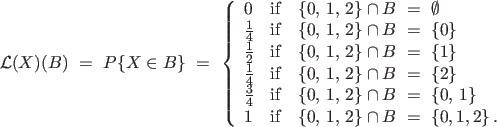
Then $ X$ takes values from $ \{0,  1,  2\}$. The distribution function of $ X$ is
\begin{displaymath}
{\mathcal L}(X)(B) \ = \ P\{X \in B\} \ = \
\left\{
\be...
..., 2 \} \cap B \ = \ \{0, 1, 2\} \, .\\
\end{array}
\right.
\end{displaymath}
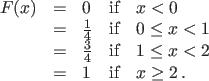
The distribution function of the random variable is given by
\begin{displaymath}
\begin{array}{lllll}
F(x) & = & 0 & {\rm if} & x < 0\\
&...
...leq x < 2\\
& = & 1 & {\rm if} & x \geq 2   .
\end{array}
\end{displaymath}