Theorem 1.1 (Jordan Curve Theorem):
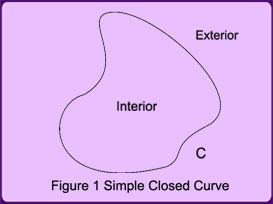
A simple closed curve separates the plane into two disjoint
open connected sets precisely one of which is bounded.
The theorem was used by Jordan in his formulation of Cauchy's theorem.
Though the Jordan curve theorem no longer
plays a central rôle in complex function theory it is nevertheless
indispensable in many other branches such as
ordinary differential equations. Let us consider the (non-trivial) problem of
locating periodic solutions of systems of differential equations.
In planar domains, a useful criterion is given by the following
Theorem 1.2 (Poincare Bendixon):
Suppose given a planar system of differential equations
 |
1.1 |
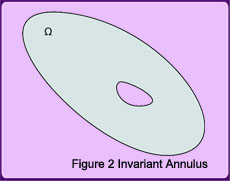
where  and and  are smooth functions in the plane. Assume that there is an
annulus are smooth functions in the plane. Assume that there is an
annulus  not containing rest points1 and invariant under the flow of the differential equation2. Then must contain periodic orbits.The proof of this important result requires the Jordan curve theorem ([8], pp. 52-54).
The analogue of theorem (1.2) is true for differential equations on the sphere but is false for differential equations
on the torus.
The Poincaré Bendixon theorem may be used to prove the existence of limit cycles for the Van der Pol oscillator not containing rest points1 and invariant under the flow of the differential equation2. Then must contain periodic orbits.The proof of this important result requires the Jordan curve theorem ([8], pp. 52-54).
The analogue of theorem (1.2) is true for differential equations on the sphere but is false for differential equations
on the torus.
The Poincaré Bendixon theorem may be used to prove the existence of limit cycles for the Van der Pol oscillator
by finding an invariant annulus for the flow ([8], pp. 60-61).
Another result from the theory of ordinary differential equations is the following result stated for
planar systems (1.1) but holds in higher dimensions also. A proof may be given using
Stokes' theorem or the Brouwer's fixed point theorem (see [8], p. 49).
1.These are the common zeros of the pair P(x; y) and Q(x; y).
2. This means a trajectory (solution curve) starting at a point of stays in for all times. |
|

